Publications
2026
- XAI
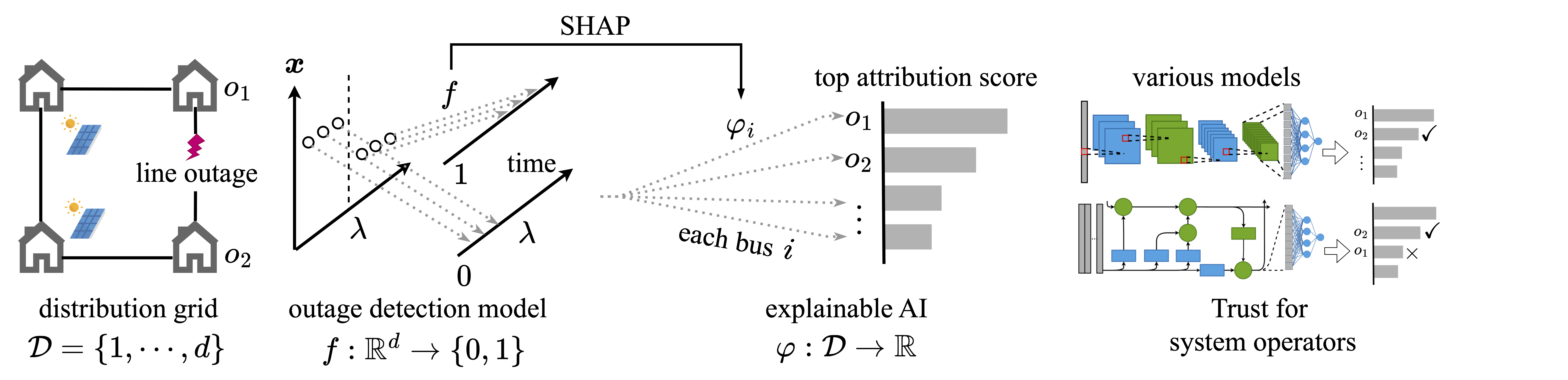 Evaluating the Trustworthiness of Machine Learning-based Outage Detection in Distribution Grids Using Explainable AIChenhan Xiao, Xiangyu Zhou, and Yang WengIEEE Transactions on Smart Grid, 2026
Outage detection in distribution grids increasingly relies on machine learning (ML) models for their scalability and fast inference. However, their black-box nature limits practical adoption, as operators require insight into how decisions are made to ensure trust and safety. This paper introduces a physics-based interpretability framework that enables utilities to assess not only the accuracy but also the physical consistency of ML-based outage detectors. Leveraging the Shapley value to quantify the marginal contribution of each bus to model predictions, we exploit a unique advantage in power systems: the true cause of the outage (e.g., the faulted bus) is known, which enables direct verification of explanations. We propose domain-adapted interpretability metrics (SHAP-Accuracy, SHAP-Recall, SHAP-F1) to quantify whether a model attributes importance to physically relevant features. Our evaluation across diverse ML architectures reveals that some high-performing models rely on spurious correlations rather than true outage indicators, an insight that traditional accuracy metrics fail to reveal. To support these findings, we develop a theoretical framework that models outage-induced shifts in the data distribution, and shows why physically consistent models should localize attribution near the faulted buses. By aligning explainability with system physics, our method provides a quantitative framework for selecting trustworthy ML models in outage detection tasks. Extensive experiments on four real-world feeder systems show that convolutional neural networks (CNNs) maintain physically aligned explanations under varying system sizes and noise levels, highlighting their robustness for reliable outage detection.
@article{11670554,
  author = {Xiao, Chenhan and Zhou, Xiangyu and Weng, Yang},
  journal = {IEEE Transactions on Smart Grid},
  title = {Evaluating the Trustworthiness of Machine Learning-based Outage Detection in Distribution Grids Using Explainable AI},
  year = {2026},
  volume = {},
  number = {},
  pages = {1-1},
  keywords = {Modeling;Signal detection;Measurement;Convolutional neural networks;Voltage;Transformers;Accuracy;Timing;Long short term memory;Power systems;Outage detection;distribution grid;trust for system operators;explainable AI;Shapley value},
  doi = {10.1109/TSG.2026.3728733}
}
2025
- XAI
 Owen-Based Semantics and Hierarchy-Aware Explanation (O-Shap)Xiangyu Zhou, Chenhan Xiao, and Yang WengIn 2025 IEEE International Conference on Data Mining (ICDM), 2025
Shapley value-based methods have become foundational in explainable artificial intelligence (XAI), offering theoretically grounded feature attributions through cooperative game theory. However, in practice, particularly in vision tasks, the assumption of feature independence breaks down, as features (i.e., pixels) often exhibit strong spatial and semantic dependencies. To address this, modern SHAP implementations now include the Owen value, a hierarchical generalization of the Shapley value that supports group attributions. While the Owen value preserves the foundations of Shapley values, its effectiveness critically depends on how feature groups are defined. We show that commonly used segmentations (e.g., axis-aligned or SLIC) violate key consistency properties, and propose a new segmentation approach that satisfies the T-property to ensure semantic alignment across hierarchy levels. This hierarchy enables computational pruning while improving attribution accuracy and interpretability. Experiments on image and tabular datasets demonstrate that O-Shap outperforms baseline SHAP variants in attribution precision, semantic coherence, and runtime efficiency, especially when structure matters.
@inproceedings{zhou2025owen,
  author = {Zhou, Xiangyu and Xiao, Chenhan and Weng, Yang},
  booktitle = {2025 IEEE International Conference on Data Mining (ICDM)},
  title = {Owen-Based Semantics and Hierarchy-Aware Explanation (O-Shap)},
  year = {2025},
  volume = {},
  number = {},
  pages = {1741-1750},
  keywords = {Image segmentation;Accuracy;Runtime;Costs;Explainable AI;Scalability;Semantics;Polynomials;Data mining;Game theory;vision;shap;owen;image},
  doi = {10.1109/ICDM65498.2025.00187},
}